
Conventional panels have been around ever since electronics became small enough to make them viable. conventional panels are used less frequently in large buildings than in the past, but are not uncommon on smaller projects such as small schools, stores, restaurants, and apartments.
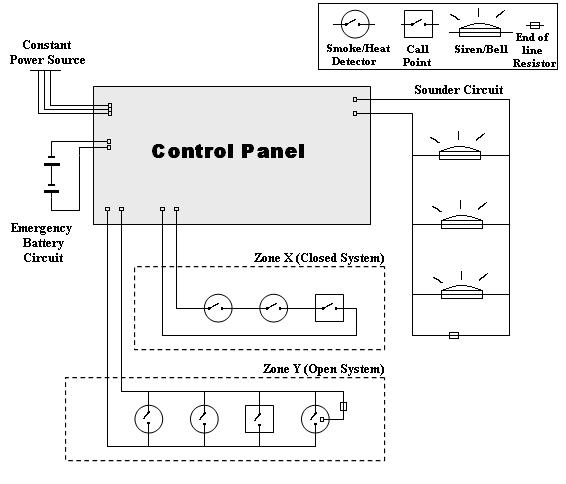
A conventional Fire Alarm Control Panel employs one or more circuits, connected to sensors (initiating devices) wired in parallel. These sensors are devised to dramatically decrease the circuit resistance when the environmental influence on any sensor exceeds a predetermined threshold. In a conventional fire alarm system, the information density is limited to the number of such circuits used.
To facilitate location and control of fire within a building, the structure is subdivided into definite areas or Zones. Floors of a multistory building are one type of Zone boundary.
An Initiating Device Circuit connected to multiple devices within in the same "Zone" of protection, effectively provides 2 bits of information about the Zone corollary to the state of the circuit; normal, or off normal and alarm or quiescent. The state of each Initiating Device Circuit within a Zone displays at the Fire Alarm Control Panel using visible indications called Annunciators.
These Annunciators may employ a graphical representation of the Zone boundaries on a floor plan (Zone map) using textual descriptions, illuminated icons, illuminated sections, or illuminated points on the map corresponding to Initiating Circuits connected to the Fire Alarm Control Panel.
For this reason, slang often inaccurately refers to initiating circuits of a Fire Alarm Control Panel as Zones.
Larger systems and increasing demand for finer diagnostic detail beyond broad area location and control functions expanded the control by Zone strategy of conventional systems by providing multiple initiating circuits within a common Zone, each exclusively connected to a particular type of initiating device, or group of devices. This arrangement forms a device type by Zone matrix whose information is particularly suited to the Tabular Annunciator In multistory buildings employing a Tabular Annunciator for Example; rows of indicators define the floors horizontally in their stacked relationship and the type of device installed on that floor displays as columns of indicators vertically aligned through each floor. The intersection of the floor and device indicators provides the combined information. The density of information however remains a function of the number of circuits employed.
Even larger systems and demands for finer diagnostic and location detail led to the introduction of addressable fire alarm systems with each addressable device providing specific information about its state while sharing a common communication circuit. Annunciation and location strategies for the most part remain relatively unchanged.
FAQ : What is the purpose of a end of line resistor or a doide in a convectional fire alarm system?
0 commentsI am assuming you mean a "conventional" Fire alarm system.
Lets talk about resistors...
It's all about supervising the circuits. (i.e. monitoring the integrity of each of the circuits.)
I am mostly familiar with what is done in the United States.
Older systems used to have a redundancy built into the wiring, 2 wires would go in and out of all of the devices and then return to the panel, this used to be called class "A" wiring (NFPA now refers to this as Style D or Style Z wiring).
Most current alarm systems use a resistor after or at the last device on a 2-wire circuit. (Class "B" wiring, or Style B and Style Y wiring under the newer NFPA 72.) The control panel or control device on an addressable system is constantly looking for that resistance as a "normal" condition. Conventional Smoke detectors, for example, will lower this resistance when activated to a point below the alarm threshold and place the panel in alarm. Pull stations and most heat detectors will short the circuit (in the U.S.) also creating an alarm (a short is basically zero resistance, although the wire itself offers a small amount).
If a wire connection is loose or is cut, the panel or device stops "seeing" the resistor and enters a fault or trouble condition. Normally, this is then looked into by a maintenance man or authorized service company.
I am continually amazed by the number of schools, hospitals, hotels, and often city and county owned properties that I enter and see the panel in a fault condition! Scary.
Diodes -
Diodes control the flow of current. Kind of like a "check valve" but for electricity.
Anyway, I don't see them as commonly as resistors on fire alarm systems. Where I have used them, it's to assist with maintaining supervision as described under resistors, but on a polarity-reversing circuit. An example would be if I had to maintain supervision of a circuit that controls a solenoid type device (like a sprinkler solenoid on a pre-action system). Since the solenoid's coil would act like a "short" I might install a diode/resistor combination just before the solenoid to maintain supervision when the circuit is not in alarm.
For more information on the styles of circuits used in the U.S., check out NFPA 72 (the National Fire Alarm Code.)
Source :
http://uk.answers.yahoo.com/question/index?qid=20060914095613AAeBlsu
If the fire alarm panel is the heart of the system, then the annunciator is the interface that actually shows you what's going on, and where. Fire alarm annunciators are used to pinpoint the trouble spots, and help the staff monitor the entire building. A fire alarm annunciator helps you make decisions on whether the fire department needs to be notified or whether the fire is small enough to be put under control by the building security.
Think of the control panel as the main "computer" and the annunciator as the "operating system," like Windows. By reading the annunciator, the building security will be better able to judge the situation. A triggered fire alarm may not necessarily mean that there is a fire spiralling out of control. For example, a person lighting a cigarette could trigger a false alarm.
All the devices in the entire system are wired and interconnected on the annunciator, making it easy to get a reading of the situation right off the bat.
Most fire alarms have the segment location of the alarm showing on the screen. There are 2 buttons on the panel, one of which is used to acknowledge the alarm and automatically notify the fire department via a phone line attached to the computer. Don't worry, the other button is used to silence the alarm in case of a false alarm.
The fire alarm annunciator also conveys other types of information, like the working status of the fire alarm devices, as well as the sprinkler system. These are represented by LED lights and data which vary from model to model. Fire alarm annunciators can malfunction for a variety of reasons though. So, keeping the fire alarm annunciators in good working order is vital for the health of the entire fire alarm system.
This type of cable for installation of fire alarm by following the standards of the world is kind of a single cable with a size of 1.5 mm to 2.5 mm. The cable that serves to deliver DC current from the Detector to the panel.
If the election is one type of cable can result in failure of communication between devices. Every job and my duty to mengawasnya mendpatkan, I always pay attention to the type of cable used. Is it standard or not. I always throw away cables that do not follow safety standards, especially for building Fire Protection system.
Below is the type of cable that I recommend and you can get it easily. 3SGZRBFT4BU3

